
AI models to optimize processes and improve customer experience
Artificial Intelligence (AI) has transformed how companies operate, offering innovative solutions to increase efficiency, improve customer experience and…

Artificial Intelligence (AI) has transformed how companies operate, offering innovative solutions to increase efficiency, improve the customer experience and optimise internal processes.
Within this universe, generative AI models play a central role, enabling technology to be applied in specific and highly effective ways.
In this article, we explore the main AI models, their applications, and how to integrate them into strategic projects. We also understand how Salesforce Einstein, the CRM's central AI, is an ally in improving your business experience comprehensively. In practice, these models support the Agentforce AI agents, the CRM's autonomous layer. Keep reading!
First of all, what is Artificial Intelligence?
Artificial Intelligence (AI) is the simulation of human intelligence processes by machines, especially computer systems. These processes include learning (acquiring information and rules for using it), reasoning (using the rules to reach approximate or definitive conclusions), and self-correction.
In simpler terms, AI allows machines to "think" and "learn" like humans, enabling them to perform tasks that only we could do before.
The advancement of this field has been made possible by AI models, which can be described as algorithms trained to understand, interpret, and act on data. These models can range from basic solutions to sophisticated architectures that use deep learning and advanced techniques such as generative AI.
What are the most common AI models?
There are several types of AI models, each designed to meet specific needs. Among the most widely used are:
Machine Learning
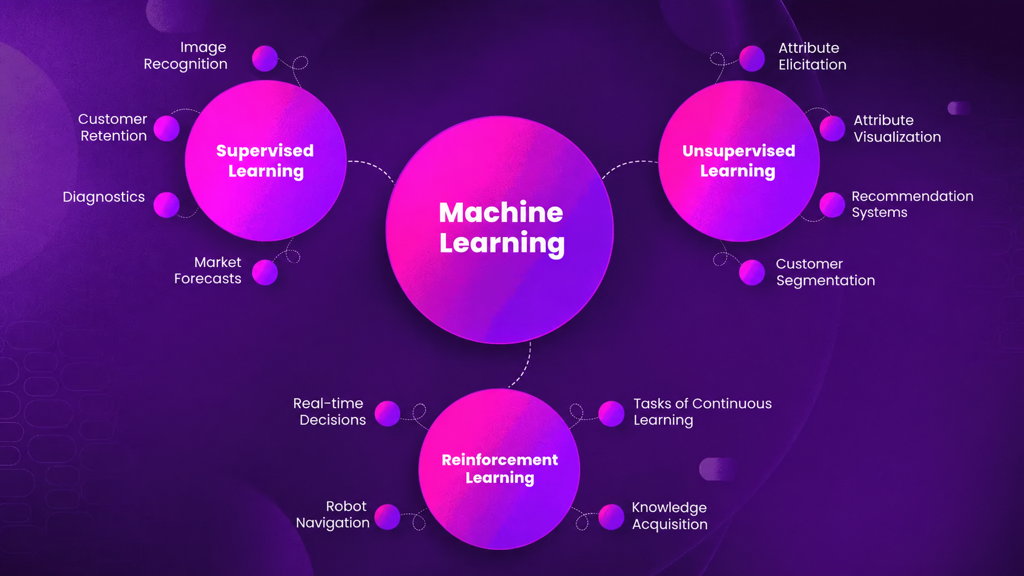
Machine Learning is a subfield of Artificial Intelligence that enables computer systems to learn from data, identifying patterns and correlations and making decisions with minimal human intervention.
Through algorithms, Machine Learning systems analyse large volumes of data. Based on this information, they can make predictions, take decisions and even generate new data. For example, a film recommendation system uses Machine Learning to suggest titles based on your previous preferences.
We prepared an image to make understanding easier.
Semi-supervised
Semi-supervised learning models use a combination of labelled and unlabelled data to train AI systems more efficiently.
In this process, labeled data helps guide the model, enabling it to interpret and learn from unlabeled data.
This approach stands out in situations where obtaining labelled data is complex and costly, such as healthcare, where strict regulations make access to sensitive information more challenging.
Practical examples of this technology include algorithms for text preprocessing and web content-classification tools.
Unsupervised
Unsupervised learning models work exclusively with unlabeled data, learning to identify patterns and organize information autonomously.
They can group data into clusters, creating categories based on characteristics identified during training.
To implement this type of solution, machine-learning engineers use techniques such as autoencoders, K-Means algorithms, and hierarchical clustering methods, constantly seeking to improve the accuracy of results.
Reinforcement models
Reinforcement learning models learn through direct interaction with the environment, without the need for pre-labeled data.
With every decision they make, they receive a reward if they achieve the expected outcome or a penalty if they fail, adjusting their behaviour based on this feedback.
This technique enables algorithms to tackle more complex challenges compared with supervised or semi-supervised methods.
Generative AI
Generative AI models are designed to create new data that resembles the patterns of the data used in their training.
They can generate various types of content, such as text, images, audio and videos. One example of this technology is ChatGPT, which uses NLP (Natural Language Processing) to interact and answer questions.
Meta-learning
Meta-learning models are designed to learn how to solve problems in a general way, rather than focusing on a single specific task.
Rather than only processing data to find specific solutions, these models develop skills that allow them to adapt quickly to new challenges, using resources such as memory and computing capacity in an optimised way.
This approach is useful when training data is limited or when companies are still defining how to apply AI in their operations.
In addition, cloud-computing platforms such as Google AutoML make it easier to train customised models, enabling professionals with limited experience to explore the benefits of machine learning.
Reasons to implement AI models in your project
Artificial Intelligence and generative AI are transforming how companies operate, offering a range of benefits that can drive growth and competitiveness.
Increase operational efficiency
With intelligent automation, activities such as data analysis, document triage, and even customer service can be performed faster, reducing the need for human intervention.
In addition, AI can identify bottlenecks in internal processes by analysing large volumes of data in real time, something that would be unfeasible manually. Intelligent systems can suggest continuous improvements, adjusting workflows to achieve greater productivity and eliminate waste.
For example, in logistics, machine-learning algorithms optimise delivery routes, saving time and fuel. Another example is in factories, with AI-based predictive maintenance that anticipates failures before they become serious problems, avoiding disruptions.
Gain greater business predictability
AI-based predictive models can evaluate variables such as customer behavior, market fluctuations, economic trends, and even external factors such as weather or global events.
With this information, companies can anticipate demand, adjust inventory and even predict sales declines or peaks, minimising surprises and improving decision-making. If you use Salesforce, Salesforce CPQ is ideal for automating your sales management, for example. This ranges from initial product configuration to generating the final quote.
In addition, AI also offers tools to simulate future scenarios, helping map different possibilities and their business implications. For example, machine-learning algorithms can predict financial performance, the impacts of market changes, or the effectiveness of new marketing strategies.
Receive valuable, precise insights
AI models can continuously adjust based on new data, ensuring up-to-date, relevant insights. This enables companies to make more informed, agile decisions, identify new market opportunities, anticipate problems, and improve customer-service personalisation.
With AI applications, companies can turn data into practical, evidence-based strategies. It is a way to optimise processes and maximise results with greater precision.
Personalise your customer experiences
AI can identify patterns in consumer behavior, such as the most purchased products, browsing times, and even specific interests, creating detailed profiles for each customer.
With this information, companies can offer personalised product or service recommendations, improve customer service and adapt marketing campaigns to meet each consumer's specific needs, increasing satisfaction and engagement.
In addition, AI applications can optimise personalisation in service channels, such as chatbots or virtual assistants. These technologies can interact naturally and efficiently with customers, answering questions, resolving problems, and even anticipating needs.
Salesforce AI
Salesforce API offers a powerful artificial intelligence platform called Einstein.
Salesforce Einstein is an integrated artificial-intelligence platform designed to offer personalised solutions. The platform uses customer data to improve the sales, service, marketing and commerce experience.
With Salesforce Einstein, it is possible to create personalized AI assistants for different workflows. The platform is secure, with a trust layer that protects sensitive data.
And beyond all this, Salesforce is open to integration with AI models from different providers, maximising ROI and business productivity.
Examples of Salesforce Einstein use:
-
Sales Cloud: the platform helps sales representatives identify the best business opportunities, personalise proposals and increase conversion rates.
-
Service Cloud: Salesforce Einstein streamlines customer service by automating tasks such as case classification and solution recommendations.
-
Marketing Cloud: the AI tool optimises marketing campaigns, personalising messages and increasing audience engagement.
A CRM integration with WhatsApp can be considered another Einstein differentiator. With the NLP tool applied to interaction data, it is possible to automatically respond to messages, carry out precise customer segmentation and provide real-time solutions.
This integration facilitates direct, personalised communication with customers, maintaining a continuous flow of interactions while AI analyses and optimises every conversation, resulting in a more agile, personalised experience.
Implement AI models in your Salesforce
With solutions offered by the Salesforce API, such as NLP integration, AI applications, and other integration possibilities, the AI models in your Salesforce will be best-in-class.
In addition to Einstein itself and Data Cloud with tools such as Generative AI, companies can transform their processes by automating workflows and offering a personalised customer experience, whether B2B or B2C.
O Salesforce developer will help you implement AI models that can be applied to data analysis, workflow automation, and improved interactions, making Salesforce more intelligent and efficient.
With guidance from a specialised Salesforce consultancy such as Weenow, you can maximise your platform with AI models, improving the accuracy of information, agility in decision-making and effectiveness of automated processes.
Continue reading
Related posts

Salesforce Data Cloud (Data 360): the enterprise guide for 2026
What Salesforce Data Cloud (renamed Data 360) is, how Zero Copy works and why it has become the foundation of Agentforce. The 2026 enterprise guide, from concept to go-live.