
Get to know Salesforce Marketing Cloud in full
The largest CRM on the market has several clouds that are recognised as key. One is Salesforce Marketing Cloud, which helps you enhance…

The market-leading CRM has several well-known pillars. One of them is Salesforce Marketing Cloud, which helps you make the most of every moment in the customer and prospect journey.
This system has a set of tools that not only make the team's work easier but also connect with one another within the CRM. It is a way to integrate first-party data from customers and prospects, as well as manage and automate marketing campaigns.
These are important differentiators for today's labour-market reality, where digital transformation is fundamental for relating to customers, gaining more profit, and achieving greater brand recognition.
In this content, we will explain what companies do with the volume of information obtained through Salesforce Marketing Cloud, as well as the types of personalisation, automations and cost insights, with the aim of driving growth for your business.
What is Salesforce Marketing Cloud
Salesforce Marketing Cloud is a complete digital marketing platform, with a set of processes that make life easier for professionals in the field. It is also an AI-powered tool focused on Customer 360, meaning it spans the entire marketing journey cycle.
With this technology, marketers can filter target audiences, create personas and ICPs, send personalized messages, track campaign performance, and attract leads and accounts.
These functions also help optimise actions through real-time information. This means Marketing Cloud is present at every moment so marketing can support customer loyalty, increase interested users and make it easier to close new contracts.
Salesforce is known for its excellence and expertise in cloud technology, as confirmed by Gartner, which shows that the platform is a leader in organizing customer data.
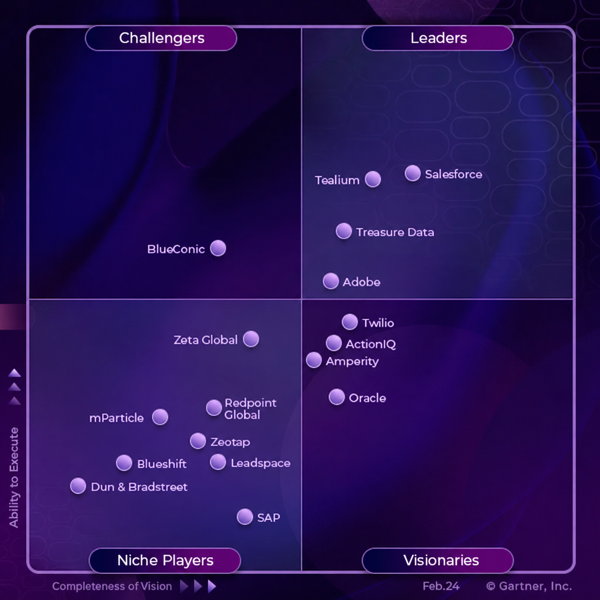
This differentiator makes the Salesforce platform essential to the routine of different companies and industries.
How can companies use Salesforce Marketing Cloud in their daily operations?
There are five major areas that make up Salesforce Marketing Cloud, considered fundamental for providing marketing professionals with capabilities. Each addresses specific aspects of digital marketing, but together they form a complete tool.
The main Marketing Cloud products are:
-
Data Cloud for Marketing (customer data platform),
-
Personalization (best next actions in real time),
-
Engagement (email, mobile, advertising, journeys, and loyalty management),
-
Account Engagement (marketing and sales alignment, lead generation and ABM)
-
Intelligence (performance insights, analytics, and reports).
Through them, it is possible to apply many processes and achieve better results. We will show some possible uses of these capabilities in the next topics.
Customer journey tracking
With Salesforce, it is possible to create and deliver personalized customer journeys to improve engagement. The focus on conversions throughout the lifecycle also makes it easier to build campaigns for leads that have entered the contact database.
There are simple tools that make customer management easier, such as the drag-and-drop block feature, to speed the creation of communication journeys. They are AI-based technologies participating in a single workflow.
In addition, it is easy to trigger automated actions according to the user experience, such as post-purchase or cross-selling, using SQL data or API events.
With all this, optimising the experience of each individual becomes more precise, because Salesforce uses real-time customer data, ensuring relevance at every stage.
Lead management in Salesforce Marketing Cloud
A tool such as Salesforce is comprehensive enough to manage all your company's contacts, classifying and scoring leads — known as lead scoring. This allows the marketing and sales teams to quickly nurture these leads for qualification, understanding whether prospects are ready to make a purchase.
When these users are not ready to buy, marketing campaigns make more sense for nurturing these leads with personalised content, delivering value and recognition for your company brand.
It is through lead management that your company makes journey touchpoints more relevant and faster. For example, using Data Cloud to activate audiences according to the channel through which users were reached.
This makes it possible to define which content and frequency are required for each lead profile. If, for example, your business is in education, you can trigger communication actions to remind leads which courses they have not yet taken on the digital platform.
In Salesforce Marketing Cloud lead management, you can also update journeys according to the latest information. Therefore, if any behaviour changes, it is possible to personalise marketing campaigns even further.
Finally, lead management enables the marketing team to quickly create landing pages and forms to engage the audience, as well as segment leads.
Email marketing campaigns
It is already well known that email is not dead and remains a fundamental channel for communication and personalized marketing campaigns. With Salesforce Marketing Cloud, the team has several ways to personalize emails, increasing campaign effectiveness through AI.
In addition to highly accurate data analysis and dashboard personalisation, your team can send personalised messages at the best times with Open-Time Email Personalization, which can optimise an email at the moment it is opened with dynamic, changeable sections.
You can choose from pre-built templates or create everything from scratch for your customers. Choose the type of communication, whether commercial, transactional, promotional or educational; Salesforce has a convenient, established library of options.
Data integration to create marketing strategies
Informed decisions are a powerful asset for being strategic in marketing, so improve your initiatives with robust analysis through Salesforce Marketing Cloud Intelligence.
With it, your team can view the journey's full performance, with integrated dashboards to optimise campaigns across email, mobile devices and advertising.
The system has easy data filtering, classification, and grouping capabilities, enabling you to create specific reports and gain insights to share with your team. The data is extremely valuable for improving campaign performance, driving engagement, and increasing the loyalty value of customers and potential customers.
To facilitate information exchange between different tools, Marketing Cloud integrates with GA4 and other analytics platforms.
Campaign personalisation across all marketing channels
With a Salesforce platform as robust as Marketing Cloud, the marketing team can create personalised experiences in every interaction. It is complete personalisation, from websites to in-app experiences, product recommendations, content delivery, and much more.
At this personalisation stage, being data-driven is a major differentiator, creating KPIs according to channel, campaign and user group. Indicators such as acquisition and retention can be measured to make personalisation even more effective.
You can also create specific banners and pop-ups according to user interests, personalizing the product or service based on customer behavior. In other words, for testing purposes, personalization provides precision and enables optimizations such as browsing speed and other details.
These insights make it easier to create personalised messages and offers, providing higher conversion rates on your website, app, and other channels – such as email, social media, and advertising formats.
Salesforce Marketing Cloud implementation
Salesforce Marketing Cloud implementation involves several stages to ensure the platform is properly configured according to your organisation's needs. The initial stage is essential for your entire company to achieve positive results, not only in profit but also in employee satisfaction, as they will have tools at their disposal to create without stress.
We have outlined the 7 key steps involved in implementing Salesforce Marketing Cloud. See below.
Planning
With any choice or purchase of a new solution, it is essential to understand the marketing goals and objectives the business wants to achieve. This makes it much easier to plan the priorities of the tool to be implemented.
Also identify the main channels the company uses. Is it email, SMS, WhatsApp, inbound marketing, forms, or paid ads? Identify these marketing channels and prioritize what should be delivered first and as thoroughly as possible — without the need for multiple reconfigurations — for the team's use.
Use this opportunity to determine the types of campaigns you want to run and how they fit into your overall marketing strategy, especially if they involve new ideas or products that need to be delivered.
Initial configuration
Every implementation goes through basic configuration, such as creating a Salesforce Marketing Cloud account, setting the account name, email domain and contact information for support needs and account security.
It is also important to configure integrations with other Salesforce tools. External systems are part of this procedure as well, where applicable.
Data configuration
If you have information in another CRM tool, it is essential to import your contact, lead and other relevant data into the Salesforce platform so that you do not lose anything already created.
If information is spread across different places – in spreadsheets, physical documents, and different tools, for example – we recommend conducting a data audit, digitising what is necessary, and importing this information into Salesforce.
It is also important to ensure that data is clean and properly formatted for effective segmentation within Marketing Cloud.
Testing and validation
Before activating your campaigns, test every configuration and check that all functions are aligned, ensuring marketing actions are not blocked at the critical moment.
This validation process also shows whether specific support will be needed if testing errors occur.
Monitoring and optimisation
Monitor campaigns in the medium term to see whether there are ways to optimise the tool and improve delivery to potential customers. This reassessment is fundamental for identifying the need for maintenance, updates, or technical support.
At times, this monitoring will show marketing indicators such as open rates, sessions, clicks, and conversions. But if you observe anything outside these patterns, a technical configuration may be required.
Training and enablement
The Salesforce platform is always evolving, so it is important that your team is well trained. This will make it possible to understand capabilities, features and even limitations. Proper guidance on best practices also helps the team achieve expected results.
Ongoing support from a specialist Salesforce consultancy
Maintain ongoing support to resolve issues, answer questions, and ensure the platform is used effectively. Count on a Salesforce consulting specialised and certified, ensuring every compliance stage and technical support as needed.
Discover WeeNow's work and see how our team can help you achieve the goals set by your company's marketing.
Continue reading
Related posts

Marketing management in 2025: trends and innovations for growth
Marketing management has always been driven by new technologies, shifts in consumer behavior and advances in personalization. In 2025, strategies such as automation, artificial intelligence…

Email marketing delivery: create successful campaigns with Salesforce Marketing Cloud
Email marketing delivery remains one of the most effective tools for nurturing leads, strengthening customer relationships, and driving sales for any…