
BRASA: how AI Native changes Salesforce project delivery
Meet BRASA, WeeNow's AI Native product connecting requirements, AI execution and expert review in Salesforce projects.
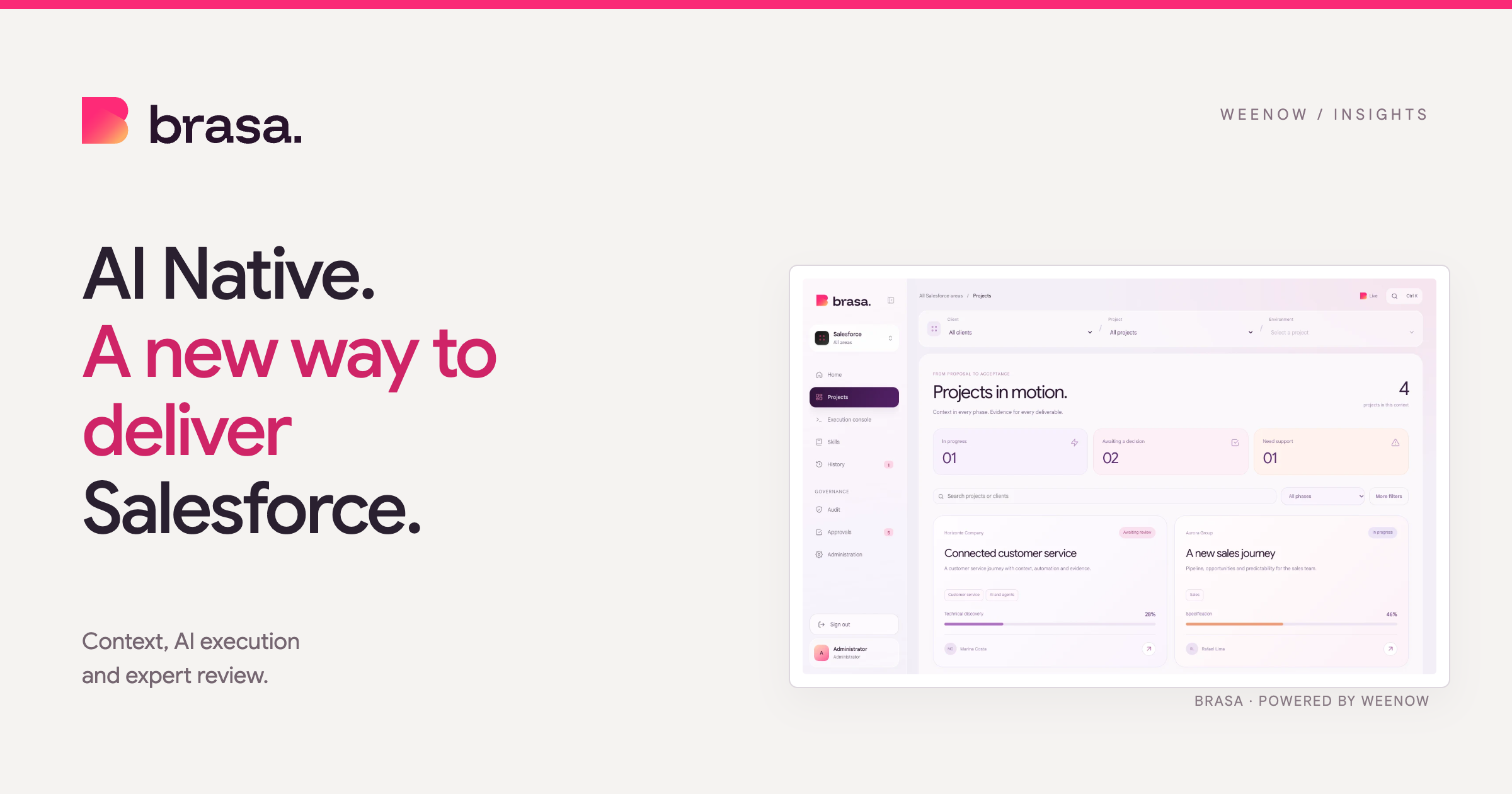
A Salesforce project may have an experienced team, an organized backlog and several artificial intelligence tools. Even so, work can lose momentum between defining a requirement, implementing it and validating it with the people who will use the solution.
Part of the difficulty lies in handing over context. One decision stays in a meeting, another in an architecture document, another in a conversation with a developer. When review time comes, someone has to reconstruct the path to understand what was requested, what changed and why the delivery is ready.
BRASA is WeeNow's AI Native product connecting this work: requirements, AI execution, expert review and delivery tracking in Salesforce projects. The platform organizes the workflow; WeeNow leads the project and takes responsibility for decisions.
This article explains what AI Native means in this context, how the model differs from using AI for individual tasks and what to consider when evaluating the approach for your company.
What is BRASA, and what is WeeNow's role?
The BRASA is a development and delivery platform for Salesforce. Here, delivery means the activities that turn a business need into a built, tested and validated solution.
The approach connects the work cycle, from understanding the request to user acceptance testing. Projects, Salesforce skills, executions and produced artifacts are organized to support those who build, review and make delivery decisions.
The distinction between the brands helps explain the engagement. WeeNow is the AI Native Salesforce consultancy. BRASA is WeeNow's product used to support project execution. The platform participates in the work, while specialists lead architecture, quality, priorities and the client relationship.
For technology leaders, this means evaluating the combination of tool and delivery method. The conversation should cover the problem to solve, the existing Salesforce environment, technical dependencies and how the client will participate in validation.
What does AI Native mean in Salesforce projects?
In BRASA's positioning, AI Native means organizing execution with AI considered from the design of the workflow. The business objective guides tasks; agents receive context; outputs are reviewed; and client validation helps guide the next steps.
The difference appears in how activities connect. An approved requirement can guide the specification. The specification provides context for implementation. Acceptance criteria help define tests. Review results identify what needs to be corrected before moving forward.
AI can participate in these activities, but its value depends on the quality of the information and decisions connecting each stage. A technically plausible response can still be wrong for the company's process.
This direction also appears in the presentation of Salesforce Professional Services, which connects AI-native delivery with expert knowledge and client participation in implementation and validation decisions. BRASA applies WeeNow's vision to its own product and working model.
AI assistance and AI Native: what is the difference?
Using AI for individual tasks can already help considerably. A developer asks for help writing an Apex class; an analyst prepares a first draft of a user story; a QA professional structures test scenarios.
With this approach, integrating the results usually depends on the people operating each tool. In the AI Native model proposed for BRASA, the focus also includes organizing context and continuity between these activities.
The comparison below is conceptual. It describes ways of organizing work, without assuming that all teams perform equally.
| Appearance | Predominantly manual execution | AI supporting individual tasks | BRASA's AI Native model |
|---|---|---|---|
| Artifact production | Primarily performed by people | AI assists selected activities | AI participates in the workflow with context and guidance |
| Context handoff | Depends on documents and team communication | Depends on integration between people and tools | Work is organized to connect stages and outputs |
| Review | Depends on the adopted process | AI responses need evaluation | Specialists review outputs and guide decisions |
| Client validation | Varies with the project model | May keep the previous cadence | The approach encourages validation throughout execution |
None of these approaches removes the need for sound architecture or clear acceptance criteria. The change is in how production, review and validation relate in everyday work.
Why does context matter so much in Salesforce development?
A seemingly simple request can involve objects, fields, permissions, integrations and automations that already exist in the organization. Creating a new rule without understanding that environment can cause unexpected behavior in other processes.
Consider a request to improve support case routing. Before implementation, the team needs to know which queues exist, how the current rules work, which users can act in each situation and what happens with exceptions.
A generic AI prompt rarely includes all this information. Discovery and specification work turn business intent into sufficient context for building and reviewing.
The Salesforce's agentic development documentation highlights the importance of organizational context, project rules and human review. It also recommends checking security, platform limits, error handling and bulk processing in generated code.
For those starting to evaluate the platform, our guide to what Salesforce is introduces the ecosystem. When the project involves code, it is also useful to understand the role of the Apex language.
How BRASA organizes the delivery cycle
The model presented by WeeNow includes six phases: presales, technical discovery, specification, development, QA and user acceptance testing. Each phase needs context, owners and an output that allows the work to move forward with sufficient understanding.
1. Presales: turn a need into a scope that can be discussed
The starting point is the company's problem. What needs to change in the operation? Who is affected? Which constraints are already known? What will count as an accepted delivery?
The proposal needs to make the scope understandable to the client and those who will execute it. When expectations remain implicit, the risk later appears as disagreement about what was included.
2. Technical discovery: understand the environment before building
Discovery examines the solution's feasibility within the Salesforce context. The data model, integrations, access and existing automations help guide architecture decisions.
At this stage, the specialist assesses dependencies and records relevant choices. AI can support artifact production and organization, while technical analysis considers the project's specific circumstances.
3. Specification: define behavior and acceptance criteria
A good specification describes what should happen and how to verify that behavior. It includes rules, exceptions and scope boundaries, using language that everyone involved can discuss.
This is particularly useful when business and technology teams need to decide together. A criterion such as "the case must go to the correct queue" still requires defining which conditions determine that queue and how to handle situations with no match.
4. Development: execute against what was approved
Implementation should consider requirements, architecture decisions and project standards. In BRASA, skills and AI execution participate in this work under expert guidance.
The goal is to connect production more closely with the available context. A component, automation or class needs to be evaluated against the expected behavior and its relationship with the existing environment.
5. QA: verify behavior and record results
QA is the quality assurance stage. Tests should help determine whether what was built meets the requirements, including error and exception scenarios.
The result needs to support a decision. A list of tests that have not been executed does not demonstrate system behavior. Likewise, a passing test may cover only part of what the user needs to do.
6. User acceptance testing: validate with those who know the operation
During user acceptance testing, the client checks whether the solution meets what was agreed. The validation script, evidence and outstanding issues help organize that conversation.
Feedback may identify a defect, a question or an additional need. Distinguishing these situations makes it easier to decide the next step with greater clarity about scope and delivery.
A practical example: mapping objects, fields and Flows
Imagine a company looking to improve service in Salesforce Service Cloud, but needing to understand existing automations before proposing changes.
The initial request might be: "We need to map the objects, fields and Flows used in customer service." Flow is a Salesforce automation tool; in this scenario, understanding automations is part of the technical assessment.
The BRASA demonstration includes an execution related to this type of activity. It shows the request, the execution sequence and an inventory-style result, with references for review.
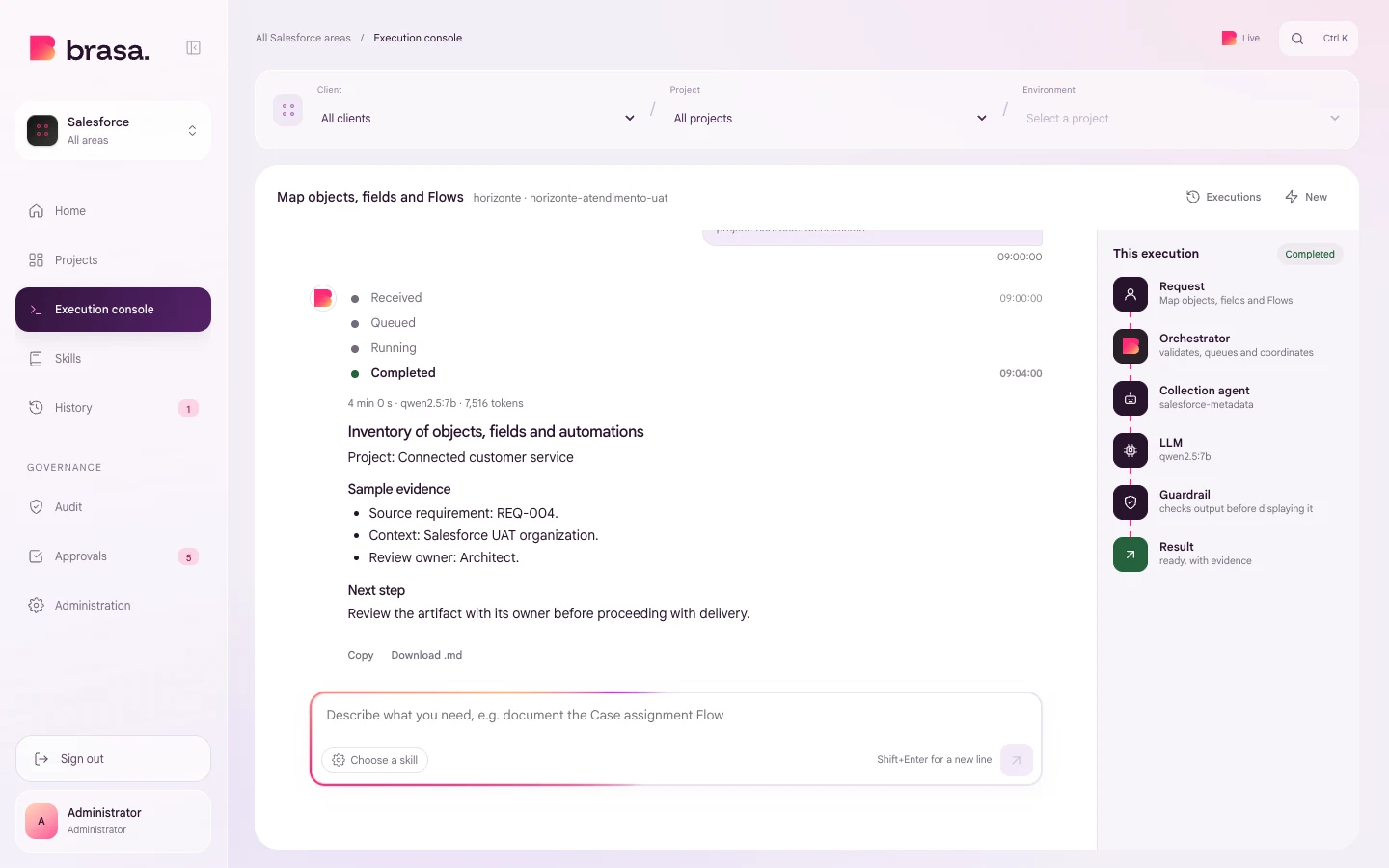
Demo environment with illustrative data. The image does not represent measured client results.
The value of the example lies in the workflow. The request receives context, execution produces an artifact and the owner reviews the material before proceeding. The architect may identify a missing dependency, request an adjustment or use the assessment to discuss the solution.
This care prevents treating the first generated response as a technical conclusion. The inventory's usefulness depends on how accurately it reflects the environment and what the team can decide from it.
What can managers track in BRASA?
The product screens show different perspectives on the work: overview, projects, skills catalog and AI execution. Each addresses a management or operational question.
The projects view brings together phases, owners and progress. The catalog organizes skills by specialty and stage. During execution, the team follows the request and the result produced for analysis.
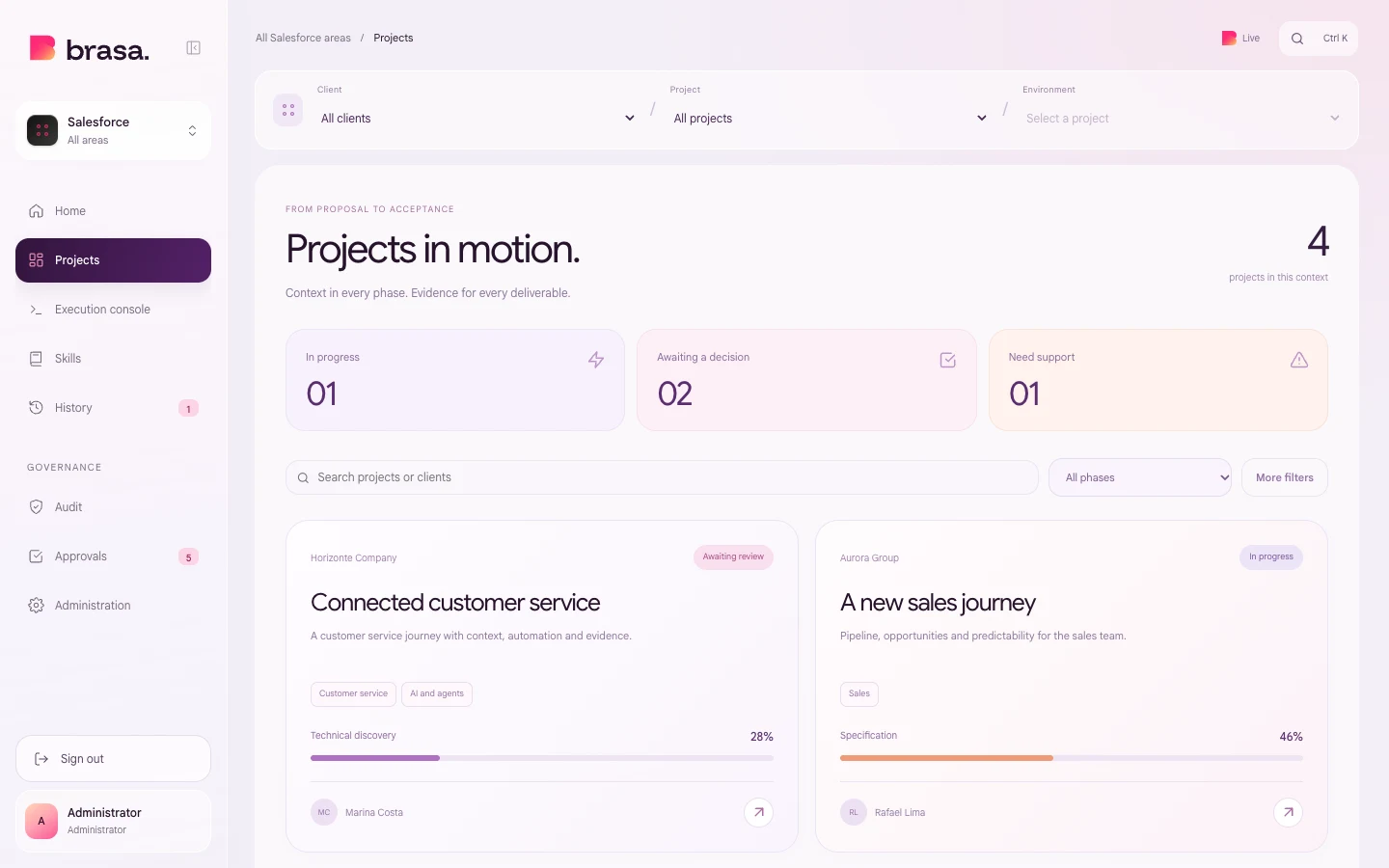
Product demonstration screenshot. Names, projects and indicators are illustrative.
For managers, the most useful question is often specific: which decision is pending, which delivery needs review or which information is missing to move forward? The platform should support that conversation with enough context for the owner to act.
During the demonstration, ask to walk through a complete example. Start with the requirement, observe what was produced and finish with the review. This helps you assess how the product fits your team's routine.
AI Native and Fast Delivery Center: where can greater speed come from?
The term Fast Delivery Center is part of WeeNow's and BRASA's positioning. The approach aims for greater agility by combining AI execution, organized knowledge and specialists guiding the work.
There are concrete opportunities for improvement: reducing the time needed to prepare a first version, reusing approved context, identifying questions earlier and avoiding reconstructing information at every handoff.
Results depend on the project. Complex integrations, data quality, environment availability, access to business owners and scope changes can influence timelines. The tool needs to be evaluated within these conditions.
That is why performance comparisons should start with comparable deliveries and data from completed work. To track progress, a company can observe:
- Time between defining a requirement and producing the first reviewable version.
- Time a delivery spends waiting for a decision.
- Number of revisions needed before acceptance.
- Defects found during user acceptance testing and after production release.
- How well the delivery meets the agreed acceptance criteria.
These indicators help discuss speed alongside quality. Timeline estimates should consider the scope and identified dependencies; improvements need to be tracked throughout execution.
When is BRASA worth evaluating?
The approach may suit companies implementing Salesforce, evolving an existing operation or reorganizing how their projects are delivered. Fit needs to be assessed with the WeeNow team based on the context.
Some signals justify that conversation: incomplete requirements reaching development, technical decisions that are hard to recover, slow delivery reviews and limited visibility into what is blocking progress.
The same applies to teams already using AI that need to connect analysis, implementation and QA more effectively. The opportunity is to organize the workflow, define responsibilities and assess where technology can support execution.
When choosing a Salesforce consultancy, ask for examples of how it works. Understand who reviews deliveries, how the client participates and what information is available throughout the project.
How to start a conversation about your project
You do not need a complete specification to get started. A good starting point is explaining the current situation, the outcome you want and what is making progress difficult.
If possible, bring an example request: an automation that needs changing, a pending integration, a service process that causes rework or a delivery that is difficult to validate. This focus helps make the demonstration more relevant.
From there, the conversation can explore dependencies, priorities, acceptance criteria and the participation of the people responsible. Timelines, scope and engagement terms should be defined based on this assessment.
Discover BRASA and talk to WeeNow about your Salesforce challenge.
Frequently asked questions about BRASA and AI Native
Is BRASA a Salesforce product?
BRASA is a WeeNow product focused on executing Salesforce projects. Salesforce provides the platform and its own solutions. WeeNow presents BRASA as part of its AI Native consulting and delivery model.
Are BRASA and Agentforce the same thing?
They are distinct offerings. BRASA is WeeNow's product for organizing delivery work. To understand Salesforce's approach to AI agents, see our article on Agentforce. The right combination of tools depends on the project's objective.
Does BRASA replace developers, architects and analysts?
The approach keeps specialists leading the work. AI participates in execution, while people define objectives, assess technical decisions and review outputs. The client participates in validating what is being built.
Does AI Native mean delivering any project automatically?
A project still requires business understanding, architecture, review, testing and validation. The AI Native approach organizes AI's participation in that cycle. The degree of automation depends on the activity and the environment's conditions.
How can I evaluate whether BRASA can help my company?
Present a concrete Salesforce need and ask for a demonstration of the relevant workflow. Observe how context is organized, what execution produces and how the specialist reviews the result. This assessment is more useful when it considers your operation's people and processes.
Can I see BRASA in action before defining the project?
The BRASA page provides a way to request a demonstration and talk to specialists. The initial conversation helps clarify the situation and assess the approach for the work.
Continue reading
Related posts

Salesforce Data Cloud (Data 360): the enterprise guide for 2026
What Salesforce Data Cloud (renamed Data 360) is, how Zero Copy works and why it has become the foundation of Agentforce. The 2026 enterprise guide, from concept to go-live.

AI models to optimize processes and improve customer experience
Artificial Intelligence (AI) has transformed how companies operate, offering innovative solutions to increase efficiency, improve customer experience and…